
The refurbished GPU myth: this post can save you a lot of grief.
We increasingly see demand for "refurbished" graphics cards in quote requests (RTX 3090, 4090, even the professional NVIDIA RTX 6000 Ada), as if it were an established, reliable and widely available given.
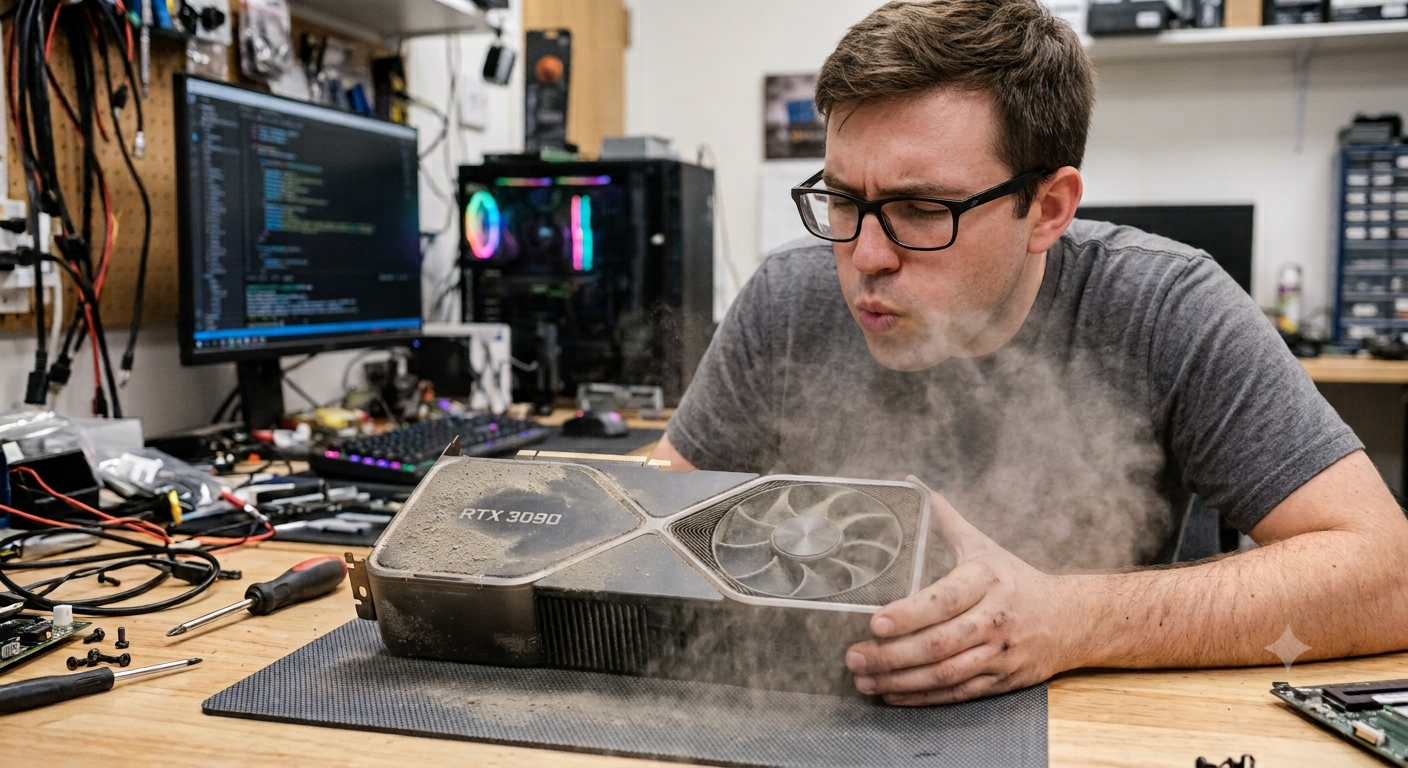
To get straight to the point: it isn’t — it’s used second-hand hardware. There’s also barely any supply, because newer GPUs are much more expensive, meaning the old cards aren’t simply being replaced.
”Refurbished” is a misleading label
The word “refurbished” suggests a product has been restored to near-new condition after its first user — renewed or revitalised. The reality is grimmer: the term is nowhere legally defined or regulated, so anyone can stick it on anything.
An American GPU market analysis puts it aptly: a refurbished GPU without warranty is in practice often nothing more than a used GPU with a prettier name (source). A Slovak GPU specialist confirms this from a European perspective: “refurbished” without documentation from a private seller can simply mean dust was blown out of the cooler. According to the same source, the right question isn’t “is this refurbished?” but rather: what exactly was done to it, and who stands behind that? Precisely the information most sellers don’t provide (source).
There is no real refurbished industry for GPUs
NVIDIA and AMD don’t refurbish cards themselves. Most “refurbished” GPUs come via traders, distributors and anonymous resellers who invent the label themselves — ranging from a proper 72-hour burn-in to literally a card that’s briefly switched on to check it’s not dead. Even less critical sources acknowledge this: some “refurbished” cards are simply lightly cleaned mining GPUs under a new label that pass a basic test but may internally already have VRM wear, memory degradation or thermal fatigue (source).
The hidden damage you can’t see
A card can look perfect on the outside while the PCB and components are internally at end of life. A professional GPU repair service puts it bluntly: the most expensive mistake with a second-hand GPU is assuming that “it boots” also means it’s healthy. Many defects only surface under load, after warming up, or during memory-intensive tasks (source).
What you can’t see — even on a card with a clean cooler and fresh paste:
1. PCB damage from thermal cycling
An RTX 3090 that ran for months at 110–120°C VRAM junction temperature sustains damage invisible to the naked eye: micro-cracks in solder joints, rock-hard thermal pads, power delivery components that ran well above spec. You only notice such damage when the card crashes after half an hour under load (source).
2. VRAM degradation
A card can game for hours with degraded memory without you noticing, because gaming loads the framebuffer sequentially and rarely fully for long periods. LLM inference loads every memory bank non-sequentially and exposes bit-flip errors that gaming simply ignores (source). This makes it a crucial point for anyone wanting to use an RTX 3090/4090 or RTX 6000 Ada for AI inference: that workload stresses the memory in a completely different way to gaming, exposing damage that had remained hidden until then.
3. VRM wear and power damage
Mining cards often had a modified BIOS, raised power limits or modified shunt resistors. This too is invisible without full inspection. Such cards often barely made it to the end of their warranty period and are now sold as “lightly used,” with tens of thousands of power-on hours and electrical damage that only manifests when you demand 30 minutes of 350 W sustained inference (source).
4. Connector damage on the 12VHPWR
Especially with the RTX 40 series, the 16-pin connector problem is well known. Melted or discoloured connectors indicate overload, and even if such a connector has been replaced, you don’t know how much damage the PCB has already sustained. At any sign of heat damage to the connector, you’re best off returning the card immediately: it’s both a fire risk and evidence of long-term overload (source).
Warranty: the only thing that makes a difference — and it’s usually missing
Warranty is the only thing that truly makes a difference between “refurbished” and “dangerously used.” But that warranty is often absent. NVIDIA’s factory warranty is non-transferable, so a second-hand RTX 4090 has zero days of factory warranty. If a seller offers 3 to 6 months (which is already generous), you’re on your own after that for a card worth €1,500+.
For the RTX 6000 Ada the story is even more painful: new, you buy it for around €8,000 with 3 years warranty via the NVIDIA Long-Life Programme. Refurbished units currently appearing on the market typically offer no more than 30 days return rights and no replacement — for a card that may have run 24/7 in a professional environment, with no knowledge of what happened to it.
Even the gaming press warns
The second-hand GPU market is described in the gaming press as a landscape full of scammers, with mining and AI usage as a real degradation risk alongside the usual concerns with anything second-hand (source). Visible physical damage on a freshly purchased second-hand card should immediately set off all alarm bells: a card that wasn’t treated with respect is more vulnerable to crashes, overheating and thermal throttling (source). And if a seller refuses to run a simple benchmark or stress test, that’s a serious red flag: there’s evidently something to hide (source).
Precisely that evidence (burn-in logs, thermal data, documentation of replaced components, serial number tracing) is missing from most “refurbished” offerings.
Our conclusion
“Refurbished” isn’t an established standard but a label anyone can stick on anything. What it should mean (full inspection, component replacement, stress testing, documentation) is in practice rarely what it is.
In practice, with a “refurbished” GPU you’re buying:
- a card with unknown thermal history;
- a card whose PCB and solder integrity cannot be established without destructive examination;
- a card without factory warranty and with limited or absent seller warranty;
- a card where “refurbished” often amounts to: dust it off and “it works.”
What we at Ikbenstil Computers stand for: computers, workstations and servers assembled with new components from reliable sources, with solid factory warranty.