
The problem everyone is ignoring (and the solution)
We receive many requests for AI systems. Almost always these involve NVIDIA GPUs. Nowadays that comes with a price tag you need to be sturdy for. But there is an alternative — and it's very good.
Why run AI locally? We’ve talked about this a few times already, and now Microsoft’s CEO is weighing in too: last Sunday, Satya Nadella published a piece that’s making the AI world sit up. In a post on X with over 6 million views, he called it the Reverse Information Paradox: companies consuming AI as a service pay twice. Once with money. And once with something more valuable — their own know-how.
Every prompt, every correction your employees give when the model gets it wrong, every evaluation you carry out — they’re all fragments of institutional knowledge that the model learns. Trace by trace, correction by correction, eval by eval, as Nadella put it. The provider learns more about you than you learn about the provider. And the better you want the model to perform, the more knowledge you have to share.
It’s a fundamental problem. And it’s the answer to the question many companies didn’t quite dare ask themselves: why isn’t our AI running locally?
Only, running AI locally has become very expensive thanks to NVIDIA: an NVIDIA RTX 6000 Ada costs around €9,000. You need four for 96 GB VRAM — sufficient for a solid 70B model. Motherboard that can handle those cards: €1,500–€2,000. RAM: €2,000. PSU, storage, chassis — another €2,000. Total: around €42,000 for a single machine running a single model. An RTX 6000 Blackwell is considerably more expensive still, but does have 96 GB VRAM.
| Spec | Intel Arc Pro B70 | RTX 5090 | AMD MI300X |
|---|---|---|---|
| VRAM | 32 GB | 32 GB | 192 GB |
| Memory Type | GDDR6 | GDDR7 | HBM3e |
| Memory Bandwidth | 1 TB/s | 1.3 TB/s | 1.9 TB/s |
| TDP | 300 W | 575 W | 750 W |
| Cooling | Single fan | Triple fan | SXM / Liquid |
| Form Factor | PCIe, 2-slot | PCIe, 3-4 slot | SXM / PCIe |
| Current Price | ~€1,300 | ~€4,200+ | ~€15,000+ |
| Price per GB VRAM | €41/GB | €131/GB | €78/GB |
| Proven max local LLM | 35B MoE (BF16) | ~35B (same VRAM) | ~100B+ |
And that’s just the GPU. The CPU needs to be able to feed data to the GPU. The motherboard needs four full PCIe 16x slots. The cooling has to handle that thermal budget. It’s a data-centre spec list in an office form factor. And that’s before you even look at what’s actually running in the machine.
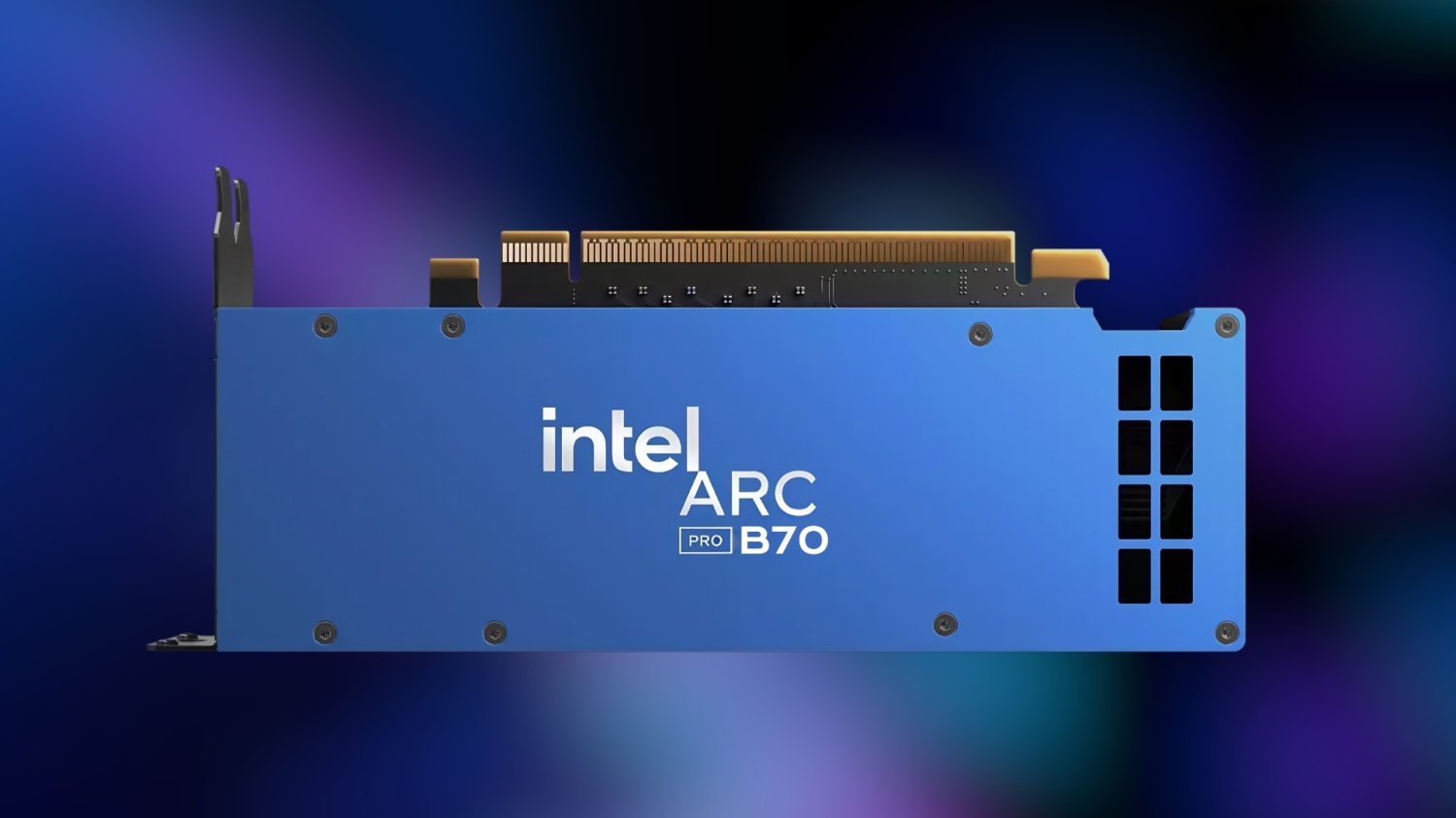
On our search for a machine that doesn’t immediately carry the price tag of an average car, we came across the Intel B70 GPU. Intel isn’t the first brand that springs to mind when we think of GPUs, but AI is different: here it’s initially not about the chip’s power but primarily about the amount and bandwidth of VRAM. So — measuring is knowing — we bought two of those B70 GPUs and built a system around them. For training and video/image creation, GPU power is then required.
Why two Arc Pro B70 cards work
An Intel Arc Pro B70 (Battlemage G31) has 32 GB VRAM and a memory bandwidth of roughly 800 GB/s. Two cards give you 64 GB. For a model like Qwen3.6-35B-A3B — a Mixture-of-Experts model with 256 experts, 8 per token, 40 layers and 262K context — that’s more than sufficient.
The MoE architecture means the model activates only a fraction of its parameters per token. The rest of the 67 billion parameters sits in VRAM, ready to be called upon when needed. This isn’t waste — it’s capacity that belongs to you.
A single B70 in an R680 motherboard with two PCIe 16x slots. 32 compute cores. 62 GB system memory. Inference runs as qwen36-35b via vLLM, with BF16 precision. PCIe bandwidth isn’t a bottleneck for inference — that’s compute- and memory-bandwidth-bound, and the B70 delivers that amply.
So we have headroom in this system, and you need it — there’s more than one user on the system at a time, plus occasionally models need to be loaded in, for example for embedding, vision, or other tasks.
We use Hermes as a wrapper with multiple profiles. The knowledge base function in particular is worth its weight in gold to us. After all, we build custom systems — nothing is standard. This means we’re constantly searching for technical information to optimally match components to user requirements. For example: what are the best SSDs for 4K data blocks? That’s a research task that can take hours. Now we store it and retrieve it when needed. Ideal.
So, returning to the Satya Nadella story: think carefully about what you do with your data. An OpenAI and Anthropic interface eats your data. Literally. And it sits neatly on those companies’ servers. We use both options — only for sensitive data we use local.
In summary: the Intel cards are an excellent solution. We wouldn’t have expected it, but a positive surprise is always welcome. Curious? Want to check it out? You’re welcome.