
New hardware 2026/2027 — Part 1: CPUs (desktop)
Last year the story was: Zen 5 versus Arrow Lake on AM5 and LGA1851. This year the story is: almost nothing appeared. AMD pushed Zen 6 on the desktop to early 2027 (servers get first dibs on TSMC's 2nm capacity), Intel did the same with Nova Lake. What 2026 brought to the desktop was supplementary rather than replacement: AMD's double V-Cache halo chip and Intel's Arrow Lake do-over.
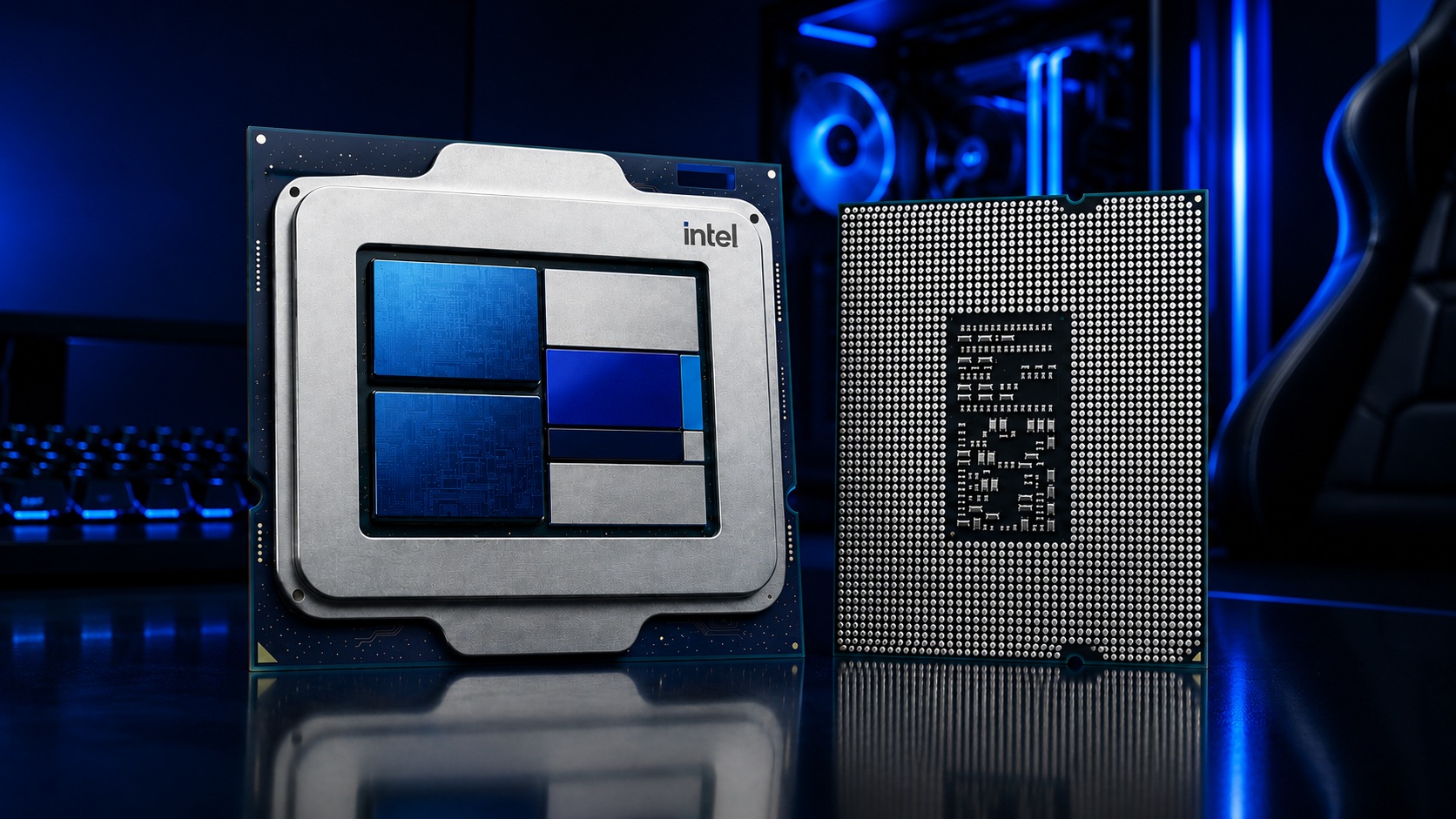
What did appear this year
Intel Core Ultra 200S Plus — the Arrow Lake do-over (March 2026)
2026 was the year of almost nothing. Both Intel and AMD are reheating yesterday’s bread, with one exception: the Core Ultra 7 270K Plus ($299, 8P+16E — 4 extra E-cores over the 265K) and the Core Ultra 5 250K Plus ($199, 8P+10E). The flagship 290K Plus (24C, 5.8 GHz TVB) topped out at ~9% more multi-core than the 285K — a refresh, not a revolution. What’s more, the 270K performed better than its big brother, leaving many wondering why you’d want that CPU. A note on the celebration: within a few weeks, ~$50 was added on top of MSRP due to component costs.
| Ultra 9 290K Plus | Ultra 7 270K Plus | Ultra 5 250K Plus | |
|---|---|---|---|
| Cores/Threads | 24C/24T (8P+16E) | 24C/24T (8P+16E) | 18C/18T (8P+10E) |
| Max boost | 5.8 GHz | 5.5 GHz | 5.3 GHz |
| MSRP | $584 | $299 | $199 |
| vs. previous gen | +100 MHz, same config | +4 E-cores | +4 E-cores, +100 MHz |
AMD Ryzen 9 9950X3D2 “Dual Edition” (April 2026)
AMD had a touch more innovation: the world’s first desktop CPU with 3D V-Cache on both chiplets: 192 MB L3 (208 MB total), 16 Zen 5 cores, 200W, $899 — the most expensive Ryzen ever, drop-in on AM5.
| Ryzen 9 9950X3D2 | Ryzen 9 9950X3D | Ryzen 7 9800X3D | |
|---|---|---|---|
| Cores/Threads | 16/32 | 16/32 | 8/16 |
| L3 (V-Cache) | 192 MB (2×64 MB) | 96 MB (+64 MB) | 96 MB (+64 MB) |
| Boost | 5.6 GHz | 5.7 GHz | 5.2 GHz |
| TDP | 200W | 170W | 120W |
| SEP | $899 | $699 | $479 |
| Gain vs. previous | +3–9% threadwork | — | gaming reference |
That was it. No new generation, no new socket, no benchmark leaps. Two chips making last year’s best slightly better — while EPYC Venice on 2nm cleans up the server market. In plain terms: all attention to the server room.
Better next year?
Both Intel and AMD have re-announced the announced CPUs — this time for early 2027. We’re curious whether both companies will get beyond the announcement… While AMD stays on AM5, Intel brings a new socket: 1954.
Intel Nova Lake (Core Ultra 400) — officially “late 2026” per CEO Tan; in practice (leaked roadmap, Tom’s Hardware Sept. 2026): mass production Q4 2026, first retail early 2027. New socket LGA1954 (LGA1851 gets just one generation — again), Coyote Cove P-cores + Arctic Wolf E-cores, up to 52 cores in the top variant (16P+32E+4LPE, coming mid/late 2027; the first wave is 28 cores), DDR5-8000/CUDIMM, NPU6 with ~74 TOPS, Xe3 graphics, and “bLLC”: large stacked L3 on the I/O tile (up to 288 MB) — Intel’s finally-born answer to X3D. Peak power up to 474W on dual-tile parts. First leaked SKU: Core Ultra 9 4970K, 28 cores, 125W, 144 MB bLLC.
AMD Olympic Ridge (Ryzen 10000) — confirmed by AMD themselves (Technical Information Portal, Aug. 2026) for AM5: 12-core CCDs (48 MB L3 per CCD), up to 24 cores/96 MB L3, N2P, 65–170W, CUDIMM support, CES 2027 reveal, launch 1H 2027. Leaks: up to ~6.6 GHz, and notably: the desktop iGPU would make way for an NPU in the I/O die — the first non-APU AMD desktop CPU with AI hardware, simultaneously ending the “free fallback graphics” AM5 had since 2022. AM5 supported through 2029 (AM6 awaits DDR6/PCIe 6.0, so ~2028+).
| Nova Lake (Intel) | Olympic Ridge (AMD) | |
|---|---|---|
| Brand name | Core Ultra 400 | Ryzen 10000 (expected) |
| Reveal / retail | CES Jan 2027 / Q1 2027 | CES Jan 2027 / 1H 2027 |
| Socket | LGA1954 (new) | AM5 (existing, through 2029) |
| Cores (flagship) | 28 first, 52 later (16P+32E+4LPE) | 24 (2×12-core CCD) |
| Cache trick | bLLC up to 288 MB | 3D V-Cache (expected, double stacks likely) |
| NPU | NPU6, ~74 TOPS | XDNA in I/O die (leaked) |
| TDP (leaked) | 65–150W on paper; 28-core BFC 296W fixed (PL1=PL2) | 65–170W (official) |
| PCIe (leaked) | 36× 5.0 platform total (Z890: 24) — not poolable to 2×16 GPU | 24× 5.0 CPU lanes, unchanged |
| Memory | DDR5-8000/CUDIMM | DDR5 + CUDIMM (confirmed/leaked) |
| Process | partly 18A, partly TSMC N2 | TSMC N2P |
| Upgrade path | new board required | drop-in on 800-series (after BIOS update) |
Clock speed unchanged — cache is the new clock
- Cache is the new clock. AMD came first with X3D2, Intel calls it bLLC, Zen 6 doubles L3 cache per CCD. Bandwidth problems are solved with proximity, not frequency — because memory (DDR5 +300% since 2024, up to 60% of BOM on budget equipment) demands it.
- The NPU moves to the desktop. Looking for an application. At least, we haven’t found one yet.
- The memory market sets the pace. At the major US manufacturers, revenues are buckling under the endless price increases for RAM, SSD, HDD and graphics cards. The counter for the last quarter reads −20%. Old hardware is being “refreshed” again and new hardware delayed.
- And 2027? The new processors are coming and that’s great — but there’s still no clarity on how large the availability of other components will be. So far there are more reports that shortages will persist until mid-2027.
While 2026 was the year of cancellation and delay, 2027 will at least begin with new CPUs. For Intel, new motherboards are coming due to the new socket, while AMD (true to tradition) carries on one more round on socket AM5. And, a small sensation: the PCI lanes on the “small” platform are finally being increased from 24 to 36 (say well-informed sources) — something that would be more than welcome.