
What can the new Intel chipsets do?
New Intel processors are on the way. For a change, there's real progress this time — and exactly where you want it.
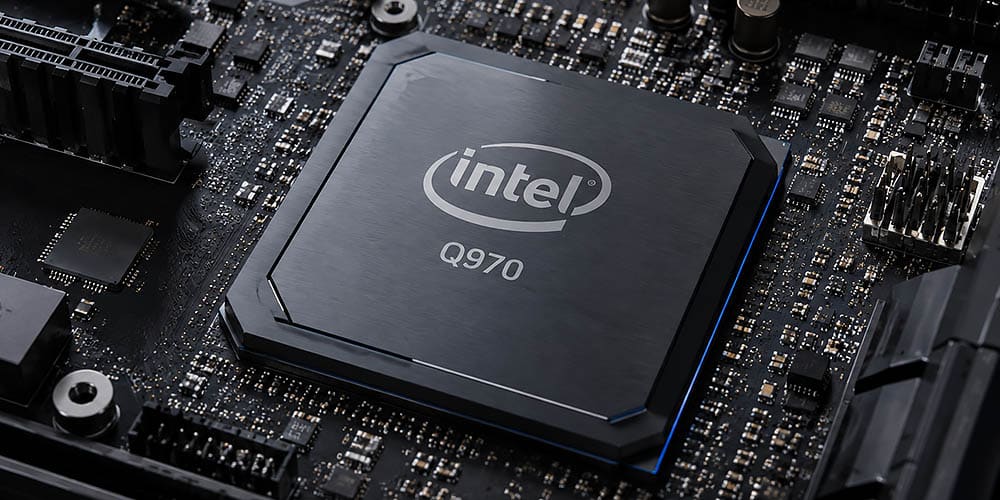
Intel 900 series: two chipsets with real progress and three that save money in the wrong places
Nova Lake-S (LGA 1954, Core Ultra 400S) arrives on the market at the end of 2026 with a lineup of five chipsets. Three of them cut costs in the wrong places. Only Q970 and Z990 are worth the effort.
The platform
LGA 1954 socket; up to 52 cores (16 HP “Coyote Cove” + 32 E “Arctic Wolf” + 4 ULP); DDR5 — CUDIMM on consumer motherboards, UDIMM on industrial. First CPUs to be announced around January, motherboards late 2026.
Q970 — the industrial/business segment
The chip that matters for fanless and embedded applications. It’s the first Q-series chip with native PCIe 5.0 downstream lanes — 8 Gen5 + 12 Gen4 from the chipset, on top of ~24 Gen5 lanes from the CPU. vPro + manageability, no overclocking, no ECC. The first industrial motherboard is already in the catalogue (Decenta M26-NVLS-ATX09): 4× DDR5-6400 up to 256 GB, ~6 PCIe 5.0 slots plus a retained legacy PCI slot, 3× LAN (2.5 GbE) and a 6 W chipset — so passive cooling still works. A genuine improvement over the Q670 it replaces:
| Q670 (now) | Q970 (new) | |
|---|---|---|
| Socket | LGA1700 | LGA1954 |
| Memory | DDR4, 128 GB | DDR5-6400, 256 GB |
| PCIe expansion | all Gen4 | Gen5 (chipset + CPU) |
| Fanless (6 W PCH) | yes | yes |
| Legacy PCI | yes | yes |
| ECC | no | no |
| vPro | yes | yes |
Real progress then, though CPU TDP plays an enormous role in this area (fanless computers). We often need to intervene here because Intel nowadays has secondary and even tertiary power steps. Concretely, this means the power supply must be able to handle it.
Z990 — the flagship for enthusiasts
The all-inclusive chipset: 12 Gen5 + 12 Gen4 chipset lanes, DMI 5.0 x4, CPU x16 bifurcation and full overclocking capabilities (multiplier + BCLK + memory — the only model that supports all three). 48 PCIe lanes in total, 2× USB4 (suitable for Thunderbolt 5), NVMe RAID, 8 SATA. The PCH die is 22% smaller than the Z890’s, but power consumption rises from 6 W to 7.9 W base / 14 W at full Gen5 load (TJmax 113 °C).
The full line-up
The two that matter are up front, the rest afterwards:
| Spec | Z990 | Q970 | W980 | Z970 | B960 |
|---|---|---|---|---|---|
| Total PCIe lanes | 48 | 44 | 48 | 34 | 34 |
| PCH PCIe 5.0 lanes | 12 | 8 | 12 | 0 | 0 |
| PCH PCIe 4.0 lanes | 12 | 12 | 12 | 14 | 14 |
| DMI Gen5 lanes | 4 | 4 | 4 | 2 | 2 |
| CPU USB4/TB4 ports | 2 | 2 | 2 | 1 | 1 |
| SATA 3.0 | 8 | 8 | 8 | 4 | 4 |
| USB 3.2 20G ports | 5 | 4 | 5 | 2 | 2 |
| USB 3.2 10G ports | 10 | 8 | 10 | 4 | 4 |
| USB 3.2 5G ports | 10 | 10 | 10 | 10 | 6 | 6 |
| CPU IA OC | Yes | No | No | Yes | No | | BCLK OC | Yes | No | No | No | No | | Memory OC | Yes | No | Yes | Yes | Yes | | ECC | No | No | Yes | No | No | | Displays | 4 | 4 | 4 | 4 | 4 |
The models we don’t recommend
B960 and Z970 are the budget variants — both have not a single PCIe 5.0 lane from the chipset, so you’re buying the new platform but not the new bandwidth. W980 is a Xeon W workstation model (ECC, vPro, no CPU overclocking) — a different market, not a desktop option. We always call these the Porsche-on-three-wheels chipsets. Yes, they’re cheaper, and you get considerably less for it.